
Toggle Attribution
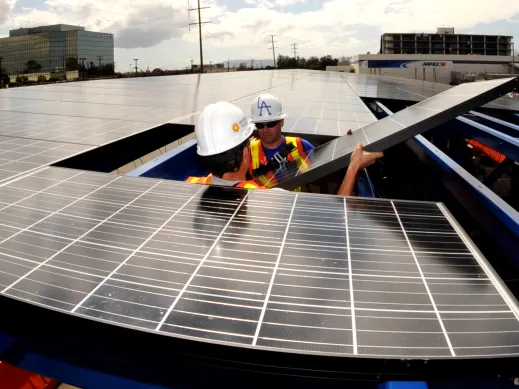
Photo given with permission by 1 Source Solar
DISCLAIMER: Please note that Greentech Renewables does not provide tax, legal, or accounting advice. This material has been prepared for informational purposes only and is not intended to provide, and should not be relied upon for, tax, legal, or accounting advice. You should consult your own tax, legal, and accounting advisors before engaging in any transaction.
Is it worth it, and what incentives are available?
The two biggest questions for businesses and commercial building owners who are considering solar are, “Is getting solar worth it in 2026?” and “Are there solar incentives available for us?” The short answer to both questions is yes, but building owners should act quickly if they want to take full advantage of available federal incentives that can significantly reduce the cost of installing a commercial solar system. This article explains which solar incentives are available to commercial building owners and what they need to know about getting solar in 2026.
The Solar Investment Tax Credit (ITC) and its New Deadlines
With the help of federal solar incentives, installing a solar system on a business or commercial building is a strategic financial decision that can significantly reduce energy costs, increase property value, secure substantial long-term savings, and provide energy independence and stability. In 2026, the most important federal incentive for commercial building owners is the solar Investment Tax Credit (ITC). Building owners who start solar project construction with systems 1 megawatt or less in 2026 can receive a 30% tax credit for the full cost of their project, including equipment and labor costs.
With the passing of the One Big Beautiful Bill Act (OBBBA) in July 2025, new commercial solar projects must meet several deadlines and criteria to receive the 30% tax credits:
- Commercial solar systems must be either constructed and placed in service by December 31, 2027, or building owners must prove that construction has commenced by July 4, 2026, to receive full credits.
- There are two ways to prove that solar construction has commenced:
- The Physical Work Test: For solar projects larger than 1.5 megawatts, proof of construction means that “Physical Work of a Significant Nature” on or off-site has occurred, such as mounting or bolting equipment or manufacturing key equipment.
- 5% Safe-Harbor Test: For projects 1.5 megawatts or under, proof of construction counts as showing that at least 5% of the total project costs have been paid by July 4th, 2026 to safe-harbor and receive the credits.
Notably, projects that miss these deadlines cannot qualify for any ITC credits for systems not placed in service by December 31st, 2027. Hence, commercial building owners should guarantee their future savings and take advantage of these incentives while they are still available.
Bonus Tax Credits
Commercial building owners can receive bonus tax credits to increase the 30% base credit by meeting additional criteria:
- Domestic content bonus: Projects that include a certain percentage of materials that were manufactured in the United States can increase credits received by 10%.
- Energy community bonus: Projects built in designated energy communities can qualify for an additional 10% tax credit.
- Low-income bonus: Projects built in a designated low-income community can also qualify for an additional 10% tax credit bonus.
Qualifying for bonus credits on top of the 30% base tax credits significantly reduces the cost of installing a commercial solar system. Talk to a licensed commercial solar installer to see if you qualify for bonus tax credits.
Other Commercial Solar Incentives
Beyond tax credits, several other solar incentives are available for commercial building owners in 2026:
- The OBBBA has permanently reinstated the 100% depreciation in one year for commercial energy systems, which include traditional solar, solar plus battery, and standalone battery systems. This means that after the first year the solar system is placed in service, businesses and commercial building owners can deduct the full cost of their solar system.
- Businesses can also receive the same federal tax incentives available for standalone battery systems without the solar array. Battery systems can help guarantee energy stability and independence.
- Most states across the U.S. have state-specific commercial solar incentives, including property and sales tax exemptions, Solar Renewable Energy Credits (commonly known as SRECs), rebates, net metering, and more. Connect with a local commercial solar installer with decades of experience to learn about your local solar incentives.
- Non-tax-paying entities can also secure federal tax credits for a solar system in the form of direct pay or elective pay.
Act While Incentives Are Available
Federal and local solar incentives are still available and highly beneficial for commercial solar projects started in 2026. Now is a better time than any for building owners to get in touch with a commercial solar installer to optimize your solar savings with the available incentives in effect.
As the leading solar equipment distribution company in the U.S., Greentech Renewables goes beyond supply by connecting commercial building owners to our network of trusted local solar installers. Our installer customers work closely with one of our 100+ locations to guide you through each stage of your solar project, from identifying your incentives to installing your solar system. Take advantage of the available solar incentives and fill out our interest form to get started.
Other Articles You Might Be Interested In

Toggle Attribution
English: Lou Hernandez, Public domain, via Wikimedia Commons



Toggle Attribution
Photo by Mills Plain Electric
1.
Tell us a bit more about your business.
2.
We’ll connect you with the right commercial installer.
3.
The installer will contact you to generate an initial project proposal.
1.
Tell us a bit more about your business.
2.
We’re connecting you to the right commercial installer.
3.
The installer will work with you to generate a project proposal. If you’d like to proceed, install solar!
Questions?